
Ludenote / Archive XIII
The register of the absent
The room was empty. The voice was not.
Eighteen pieces of evidence. Three files that contradict each other. Clocks that no longer share the same time. Recover the event order, the name behind an authorization and the contents of five seals before reopening line thirteen. A dark investigation of logic, cryptography and close reading of evidence—entirely free, with a complete ending.
Fictional archives from 2004. Erased names, altered recordings, uncertain presences. Every clue is in the records. Make their contradictions speak.
- The annexLearn the file conventions and locate both evidence strips.
- Incompatible hoursCross-reference pulses, times and assignments; separate copies from originals.
- The authorizationReconstruct five seals and attribute deletion to its documented holder.
- The restored nameAssemble the three branches to explain playback and reopen the deleted line.
Investigation branch
Clock file
Six events, three devices and a copy asserting the wrong sequence.
A01An office that receives nobody
The Friches annex is fictional. It kept broadcasts nobody was meant to hear again. On 17 May 2004, register XIII lists five staff, five stations and five badges, but only four names in the credits. The file arrives without a sender. Its cover says: “Do not look for this room on a map. It exists only here.” Three files intersect: clocks, presences and reconstruction. Contradictions are evidence to examine, never instructions to contact anyone or visit another website. No real disappearance or emergency is being reported.
ANNEXE / XIII 2004-05-17 STAFF = 5 STATIONS = 5 BADGES = 5 ACCOUNTS_REQUIRED = 0 EXTERNAL_ACTIONS = 0
A03The first shared signal
The three devices A, B and C photographed the same reference pulse. Seal R0 records a global instant, not a device clock. No reset occurred between R0 and R1. A displayed time before midnight belongs to the preceding day. Each clock runs at a constant positive rate over this interval: recover an affine transformation between displayed and global time for each one. Timestamped records A05, A06 and A07 use only these devices. Official register A08 is a later copy.
GLOBAL R0 2004-05-17 00:00:00 A R0 2004-05-16 23:57:00 B R0 2004-05-17 00:05:00 C R0 2004-05-17 00:01:30
A04Sixty minutes that last different lengths
The second pulse is not an additional event to order. It closes the calibration interval. Operators left a note: “B always finishes its minute too soon; C holds it back. Do not correct with a mere offset.” A photocopy tried to replace this note with the word fault. The original ink presses through the next sheet. All six events fall strictly between the pulses: no drift extrapolation or daylight-saving assumption is needed.
GLOBAL R1 2004-05-17 01:00:00 A R1 2004-05-17 00:57:00 B R1 2004-05-17 01:06:00 C R1 2004-05-17 01:01:00
A05The switch and the service light
Tape A is certified original. K closes the studio-microphone return to the corridor loudspeaker. P extinguishes the service light; reader power remains on. A pale margin repeats E, stamped COPY: it is a later import of a tape-C event, not a seventh event. Voices heard after K can therefore no longer come from a corridor microphone left open. Keep that limit in mind; it separates a presence from a mechanism replaying its own memory.
EVENT K | DEVICE A | 2004-05-17 00:09:00 | MIC_RETURN_OFF EVENT P | DEVICE A | 2004-05-17 00:32:00 | SERVICE_LIGHT_OFF COPY E | SOURCE A07/C | NOT_AN_EVENT
A06The receipt that precedes its cause
Tape B records R, receipt of a preservation envelope, then M, start of the credit-deletion script. B identifies the device, never a badge. The envelope was therefore received before deletion began; no outsider entered afterwards. Script M points to a physical authorization in A12. A deletion receipt is not evidence of a person’s death: this system acts on names, copies and access rights. The five staff in this file are fictional characters.
EVENT R | DEVICE B | 2004-05-17 00:15:10 | PRESERVATION_RECEIVED EVENT M | DEVICE B | 2004-05-17 00:36:31 | CREDIT_PURGE_START
A07The chair in the video return
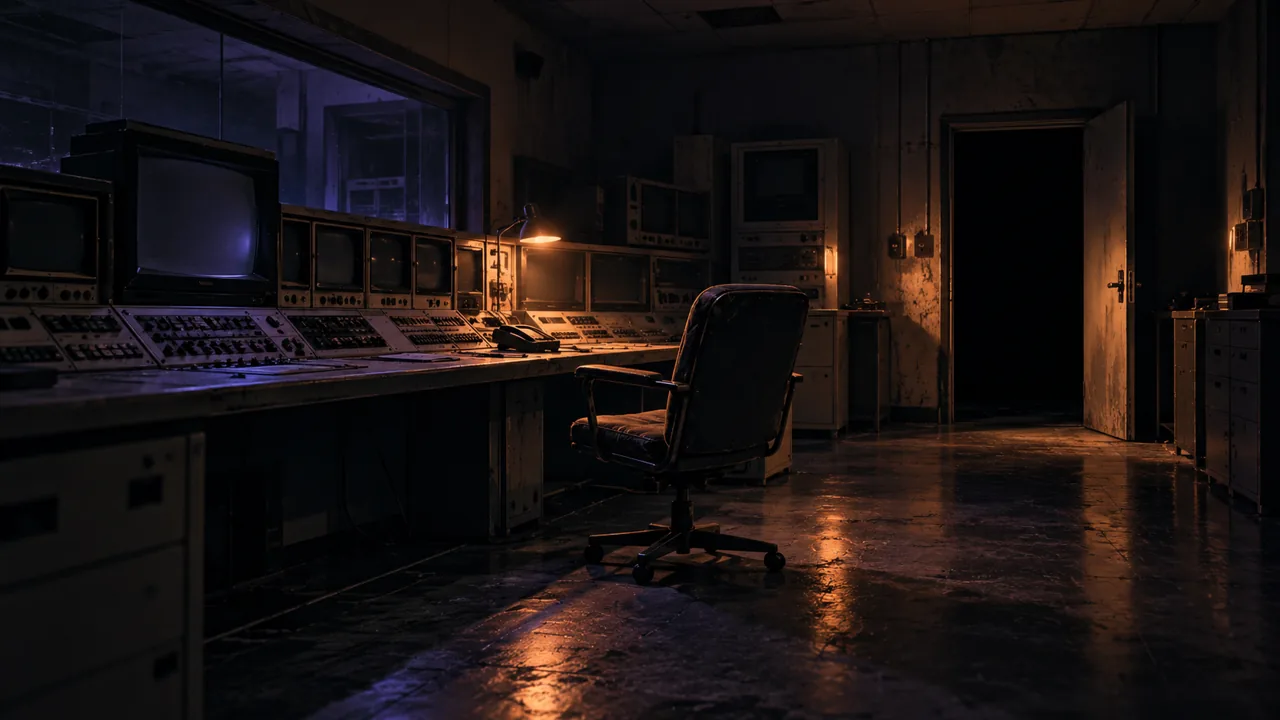
Full transcript of a fictional capture, readable without video. At V, the return shows an empty chair and a moving level meter. No body, silhouette or door entry appears. A voice says twice, with the same hesitation: “They left my voice. They removed the part that said it was mine.” At E, the return stops in the middle of the second sentence. Visible timecode belongs to C, not global time. Identical hesitations and identical meter pulses establish repetition, not an apparition. The quiet noise is continuous and contains no audio-only clue.
EVENT V | DEVICE C | 2004-05-17 00:19:21 | RETURN_PLAYBACK_START EVENT E | DEVICE C | 2004-05-17 00:49:06 | RETURN_PLAYBACK_END V FRAME 012 | EMPTY_CHAIR | METER 3-1-3-0 V FRAME 036 | EMPTY_CHAIR | METER 3-1-3-0 FRAME 012 = FRAME 036 | LOOP_CONFIRMED
A08The report that is too clean
This report is stamped EDITORIAL COPY and has no calibration seal. Its order comes from sorting printed local times across all devices. It claims the light went out before the credits were deleted and that the return began after a microphone closure “caused by an unknown person.” Correct the order from originals; do not turn this accusation into an identity constraint. “Unknown person” is contradicted by the five fixed assignments and the script receipt. This piece can be false without making the originals arbitrary: its methodological error is documented.
COPY_ORDER K R V P M E METHOD SORT_DISPLAYED_LOCAL_TIMES REFERENCE_PULSES OMITTED CERTIFICATION NONE
Cross-examine the records
Which order did the copy erase?
Recover the global time of K, R, V, P, M and E from the two shared pulses. For each device, calculate its displayed rate over 3,600 global seconds, then invert that transformation. The copy of E in A05 and reference pulses R0/R1 are not extra events. Order the six events from first to last and concatenate their letters. No events are simultaneous.
Ask for a hint
A hint reveals part of the method. Open it only if you wish.
Clock A has an offset without drift. B and C have R0→R1 spans different from 3,600 seconds. Compare corrected instants, not printed clock times.
Investigation branch
Presence file
Five people, five stations and five badges, with no room number to help you.
A02The corridor without a junction
The plan has been taken from its frame, but its filing strip survives. The five stations follow a single corridor in the stated order. For the identity records, number positions from 0 to 4. Each person occupies exactly one station and holds exactly one badge; no station, name or badge is shared. Assignments did not change during the six night events. The + and < signs describe corridor positions, never times. Certified presence records A09, A10 and A11 are constraints; accusations in an editorial copy are not.
POSITION 0 1 2 3 4 STATION LAC NEF PUITS QUAI SAS PEOPLE MIRA / ELIE / SOREN / IRIS / NOAM BADGES B1 / B2 / B3 / B4 / B5
A09Three lines beneath the paint
These three lines come from a continuity test sealed before the night. Names designate assignments, not movement. Equality and addition refer to the station numbers in A02; “two after” therefore leaves exactly one station between them. A transparent copy overlay on the plan could make MIRA appear assigned to NEF. Removing the copy overlay leaves the original relations readable. Do not assume names are listed in station order or that badge numbers indicate position.
MIRA = IRIS + 2 SOREN < MIRA NOAM = ELIE - 1
A10Voices assigned off screen
The five-channel check completes A09’s three relations. Each line is a certified position constraint in the same corridor. No witness lies here: uncertainty comes from assembling separated evidence, not a hidden liar rule. A broadcast address in the margin has been fully obscured; it is unnecessary. Reading these constraints with A02 and A09 must yield one assignment for all five names. If two configurations remain, look for an omitted constraint, never an outsider to question.
ELIE != LAC ELIE != NEF SOREN != LAC SOREN != SAS IRIS < NOAM
A11Badges are not numbered by room
The reader test was printed on a separate strip. Its equalities and exclusions, like the names, refer to A02’s positions 0 to 4. Each badge occurs exactly once. The strip names no holder: solve badge assignments, then intersect them with person assignments. B1 to B5 are stable identifiers. Do not confuse badge B3 with chronology device B. All certified A09–A11 reports are true within the fiction; there is no sixth badge or hidden station.
B2 = B5 + 2 B3 = B1 + 1 B4 = B5 + 1 B1 != NEF B1 != SAS B5 != LAC B5 != SAS
A12A deletion does not happen on its own
The original receipt for script M carries authorization B3 and reader NEF. Protocol requires the assigned badge holder to remain at the certified station during authorization; no loan or substitution is permitted or recorded that night. The action field says CREDIT_PURGE, not microphone cutoff. The corrected Chronology branch therefore reveals that credits had already been removed when the service light went out. Authorization responsibility is inferred from intersecting presence and reader strips, not from the voice heard.
EVENT M ACTION CREDIT_PURGE AUTHORIZATION BADGE B3 READER NEF BADGE_LOAN NONE ASSIGNMENT_CHANGES NONE TARGET CREDIT_LINE_13
A13The fifth name in the carbon copy
The credits’ carbon copy preserves five names and five signatures. Line thirteen attributes the voice to MIRA, signature B5, before any deletion. The later credits keep the audio; they replace only this line with “technical reprise.” The other four names remain. A12 therefore records an action against MIRA’s credit, not an accusation against MIRA. Original credit and station constraints can be cross-checked: B5 and MIRA must occupy the same station. This redundancy confirms the assembly; it does not make other relations optional.
CARBON LINE_13 | VOICE MIRA | SIGNATURE B5 LATE_COPY LINE_13 | TECHNICAL_REPRISE | NAME_REMOVED AUDIO_BYTES CHANGED = 0 CREDIT_LINE CHANGED = 1
Cross-examine the records
Who signed the deletion?
Solve the five people’s station assignments, then the five badges’ assignments. All certified relations are true and assignments are bijections. Intersect both tables with the badge and reader on receipt M. Answer with the holder’s name followed by their badge, without the room name. A13’s original attribution is an independent cross-check.
Ask for a hint
A hint reveals part of the method. Open it only if you wish.
Translate excluded stations to positions 0 to 4. Solve names and badges separately to avoid confusing device B with a badge.
Investigation branch
Return file
Five mathematical seals, then fragments of an attribution to restore.
A14What was locked behind five seals
The reconstruction file contains the five mathematical seals already scattered through the site’s margins. They form only one branch of the investigation. Their last answer is a thirteen-digit hexadecimal key; it is not yet the register code. The seals preserve a return envelope against accidental copies, not a promise of resistance to source inspection or analysis tools. The final code also requires the true order of the six events and the badge authorizing M. All three branches must meet.
SEALS 01 -> 02 -> 03 -> 04 -> 05 OUTPUT 05 = KEY[13 HEX] FINAL_INPUTS = CHRONOLOGY + AUTHORIZATION_BADGE + KEY
A15Packets that have lost their order
These return fragments are arranged by drawer labels, not by the night’s chronology. Every event has a fragment for each badge. For the final register, take only the column for the badge that authorized M, then concatenate its fragments in corrected global order. The five other events each have two digits; E has three. The result contains thirteen hexadecimal digits. Protocol A16 then explains how to use the fifth-seal key. No cell is missing and zeros must be preserved.
EVENT B1 B2 B3 B4 B5 K 71 6F 2B 39 E0 R C2 14 DA B8 55 V 48 93 DC A1 7F P 0A 5D C0 62 83 M E6 27 CE F4 10 E 184 F09 BA2 6C7 35E
A16The protocol that returns a name
The final code is a digit-by-digit XOR. Align the thirteen digits from seal 05 with the thirteen digits assembled in A15. For each column, interpret both digits as values 0 to 15 and apply binary exclusive OR; convert the result back into a hexadecimal digit. This protocol restores the original credit in its place without inventing a witness or altering the voice. A second function, REDACT, preserves only noise. Its command field is crossed out and explicitly not selected: it is not an alternative ending to guess.
SELECTED RESTORE_CREDIT OUTPUT[i] = KEY[i] XOR RETURN[i] WIDTH = 13 HEX REDACT = NOT_SELECTED A XOR A = 0 A XOR 0 = A
A17A letter never meant for broadcast
MIRA’s last text was not a distress message. She refused to let family letters read by the five staff become unattributed “technical reprises.” The register called any name returning after deletion an anomaly. The capture’s sentence came from this letter, read before the microphone closed; automatic return replayed two identical segments. The system had not created a presence. It had kept a voice while deleting the right to say who spoke. Someone knew the replay mechanism; their identity is established only by assembling authorization evidence.
PRE_RECORDED_LETTER -> RETURN_BUFFER -> REPEATED_SEGMENTS LIVE_MIC_AFTER_K = 0 NEW_PERSON_AFTER_R = 0 VOICE_OWNER = ORIGINAL_CREDIT_LINE_13
A18Open the previous lock to check this one.
The final finding can only be confirmed after the two initial branches and all five seals of the reconstructed file.
Sealed file 01 / 05
The missing squares
Fragments A (home), B (free demo) and C (privacy) describe a nonogram with 7 rows and 7 columns. R1–R7 run from top to bottom; C1–C7 from left to right. Each number sequence gives, in order, the lengths of consecutive blocks of 1 cells. At least one 0 cell separates any two blocks; 0 cells may appear before or after them. Reconstruct the unique grid. Read the 49 bits row by row, left to right and top to bottom. Add three 0s at the front, group the bits into sets of four, then convert them to 13 hexadecimal digits.
7 × 7
A: R1–R4
B: R5–R7
C: C1–C7
49 → 52 → 13
{0,1} → {0,…,9,A,…,F}Ask for a hint
A hint reveals part of the method. Open it only if you wish.
Enumerate each row’s possible arrangements; keep only those that also satisfy every column.
Sealed file 02 / 05
The witnesses’ order
The key is your stage 1 answer: one character per column, from left to right, in a grid of 5 rows and 13 columns. The 13 evidence lines are columns read from top to bottom, presented in ascending key-character order (0 < … < 9 < A < … < F). For equal characters, the original leftmost column comes first. Restore the columns, then read the grid row by row. Take the characters at positions 1, 6, 11, …, 61 (positions start at 1).
QMBXZ
NAMVY
LEMUI
XTWYI
NYGER
MNFRU
UXRPR
XARPL
PTKNM
VMZTH
YIIOA
UYQCA
UDSDD
Ask for a hint
A hint reveals part of the method. Open it only if you wish.
First number the key’s 13 columns. Sort those numbers by key character, then by column number: this gives the original position of each evidence line.
Sealed file 03 / 05
The incomplete alphabet
Build a 5 × 5 Polybius square. Read your stage 2 answer from left to right: I and J share the letter I; keep only the first occurrence of each letter. Append the missing letters of ABCDEFGHIKLMNOPQRSTUVWXYZ, in that order. Write this sequence into the square row by row. Each evidence pair gives row then column, from 1 to 5. Decode the pairs from left to right.
45 52 33 42 51 13 41 55 44 31
Ask for a hint
A hint reveals part of the method. Open it only if you wish.
The key need not occupy a whole row: its unique letters come first, followed by the rest of the alphabet without J.
Sealed file 04 / 05
The returning message
Calculate S, the sum of the previous answer’s letter values using A = 1, …, Z = 26. The number of rails is 3 + (S modulo 5). First undo the shift applied to the evidence text: use the alphabet 0123456789ABCDEFGHIJKLMNOPQRSTUVWXYZ (indices 0 to 35). For each character, subtract modulo 36 the A = 1, …, Z = 26 value of the corresponding letter of the previous key, repeated cyclically from its first letter. The result was produced by a rail-fence cipher: the original message’s 208 characters were written in a zigzag, starting on the top rail and moving down, reversing direction on each outer rail; the rails were then read from top to bottom, each from left to right. Undo the rails, then extract positions 13, 26, …, 208 from the original message.
VJHY5K606K3HM3YX80FQY4QWC0VFGU20PRSN7NUTVFKHCENNYVFETV57R5VURH5RBYP7T4YK18ANOKWMUXS5CMNPCMR2U96R38EZ413O3CU150ELI2ZZI20H55ZA4Q957VZZ3UEJY1EGV6C2XJ3IUE9UYC9H920TY941237MTN270WY0PL1L11ISG8YG6JXGP6WBAC1I49LW477V
Ask for a hint
A hint reveals part of the method. Open it only if you wish.
Undo the operations in reverse order: modulo-36 shift, then rails. Draw the 208 empty zigzag positions to determine each rail’s exact length.
Sealed file 05 / 05
The thirteenth entry
Interpret the answer to stage 4 as the hexadecimal integer k. For each row j (from 1 to 6), compute r = (b + 13 × k + j) modulo p. Find the integer x satisfying x ≡ r (modulo p) for all six rows and 0 ≤ x < 16^13. Exactly one solution lies in this interval. Write x as exactly 13 hexadecimal digits. Calculations must preserve integer precision, including beyond 2^53.
j    p       b
1    1009    917
2    1013    837
3    1019    579
4    1021    682
5    1031    330
6    1033    141
0 <= x < 16^13
Ask for a hint
A hint reveals part of the method. Open it only if you wish.
The six moduli are pairwise coprime. The Chinese remainder theorem reconstructs x modulo their product; then check the required interval.
Act IV / What remains
Cross-examine the records
Which code returns line thirteen?
Use the Chronology answer for event order and the Identity answer for authorization badge. In A15, select that badge’s column, then concatenate its fragments in corrected order. Align this thirteen-digit word with the key obtained at seal 05. Apply hexadecimal digit-by-digit XOR according to A16. Keep leading zeros. This result, not key 05 alone, unlocks the conclusion.
Ask for a hint
A hint reveals part of the method. Open it only if you wish.
The table is not in true time order. E supplies three digits and the other five events two each. XOR is neither addition nor subtraction modulo 16.
The final connection is established. The archive now preserves both versions.
Open the previous lock to check this one.
The final finding can only be confirmed after the two initial branches and all five seals of the reconstructed file.
The game ends here. No purchase, account or sharing is required to complete it.
Discover the demo investigation